Article
used with permission from the Philadelphia Junto, Richard Carreño
February
2015
Subscribe
to the Philadelphia Junto for more great articles! Subscribe here!
EXCLUSIVE PJ PHOTOS!
***
This year is the 450th anniversary of the Spanish Riding School, to be
celebrated by a gala scheduled for 7 pm at the nearby Heldenplatz on 26 June
and subsequently at the 6th Fete Imperiale. In attendance will be the Royal
Andalusian Riding School from Jerez, Spain. ***
THE PJ VISITS THE SPANISH RIDING SCHOOL
VIENNA
-- By the time we arrived at Michaelerplatz, during our visit last week, it was
already late in the day. We suspected that our visit would be rescheduled for
another day.
'No,
you're just in time for the last English-language tour,' we were told.
'Where
shall we meet?'
'Right
here. You're it.'
Not
surprisingly that we were only English-speakers really. During our week-long
stay in Vienna, we encountered few, if any, other Americans. Few, if any,
native English-speaking tourists. Time of the year?
But
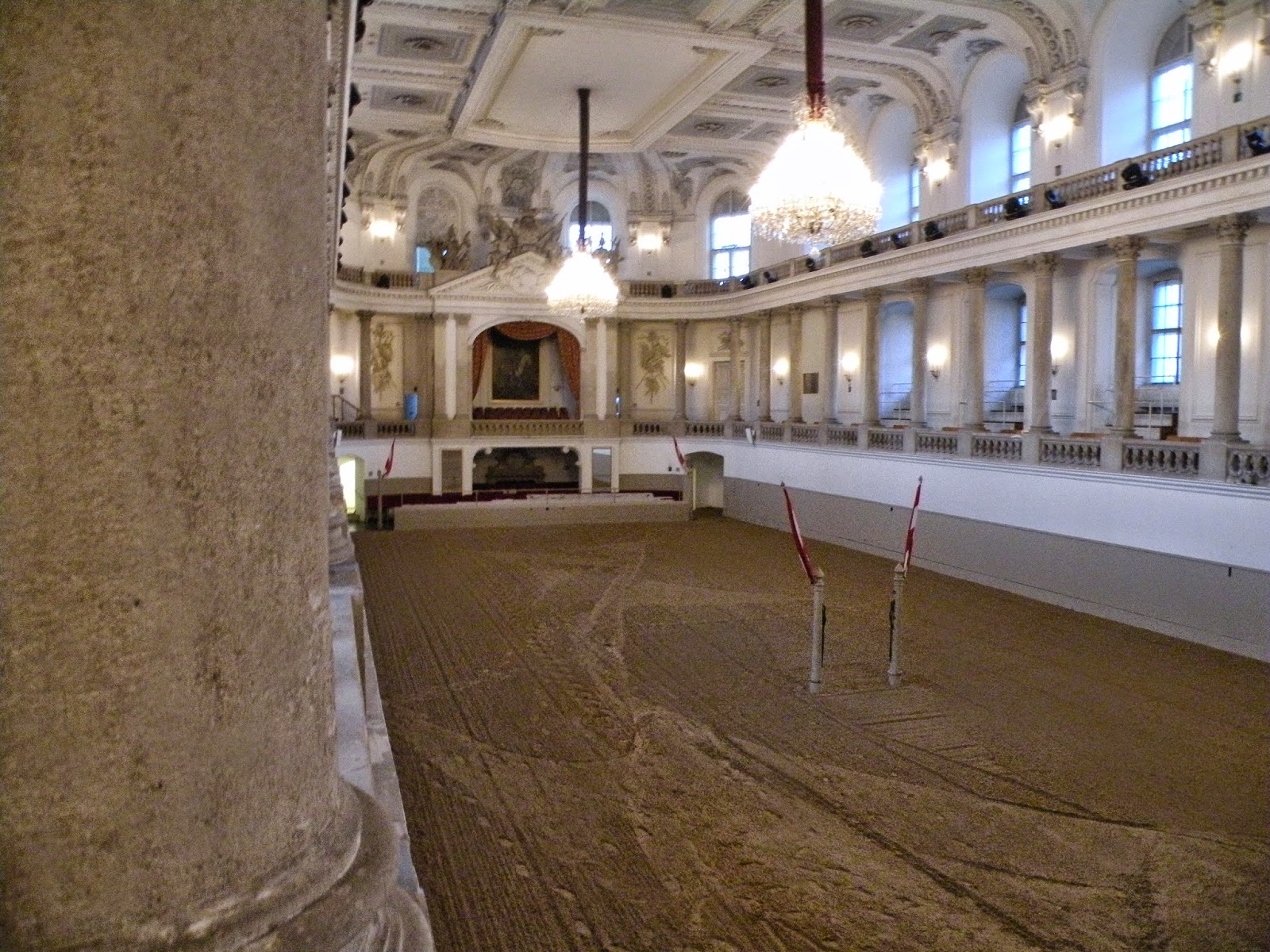
what especially was a happy result was that we were permitted to take photos,
normally banned on public tours. -- Richard Carreño
Thanks
to Wikipedia for the following:
The Spanish Riding School (German: Spanische Hofreitschule) of Vienna, Austria,
is a traditional riding school for Lipizzan horses,
which perform in the Winter Riding School (Winterreitschule) in theHofburg.
Not only is it a centre for classical dressage, the headquarters is a tourist attraction
inVienna that
offers public performances as well as permitting public viewing of some
training sessions. The presentation builds on four centuries of experience and
tradition in classical dressage. The
leading horses and riders of the school also periodically tour and perform
worldwide.
The Spanish Riding School is located
betweenMichaelerplatz and Josefsplatz near the Hofburg in
central Vienna. Performances take place in the Winter Riding School,
built between 1729–1735. The Winter Riding School is a sunlight- flooded hall,
mainly white with some beige and light grey, with a portrait of Emperor Charles VI above
the royal box and opposite the entrance (to which the riders always salute
before they ride), which measures 55 by 18 metres and is 17 metres in height.
The Spanish Riding School also has
summer stables in Heldenberg-Wetzdorf-Lower Austria. The 68
resident stallions are taken there in July and August for seven weeks, where
they are kept in stalls withpaddocks.
The horses are not schooled during this period, but instead are hacked in the nearby forest.
History
The riding school was first named
during the Habsburg Monarchy in 1572, long before the French manege of Antoine de Pluvinel, and is the oldest of its
kind in the world.[1] Records show that a wooden riding arena was
first commissioned in 1565, but it wasn't until 1729 that Emperor Charles VI
commissioned the architect Joseph
Emanuel Fischer von Erlach to build the white riding hall used today. Prior to that
time, the School operated from a wooden arena at the Josefsplatz. For a time, the riding hall was
used for various ceremonies, but it is now open to the public, who may witness
the training and performances by the stallions.
The Spanish Riding School was named for
the Spanish horses that formed one of the bases of the Lipizzanbreed,
which is used exclusively at the school. Today the horses delivered to the
Spanish Riding School are bred at the Piber Federal Stud located near the
village of Piber in western Styria, Austria.
One of the original studs used to develop the breed was Lipizza, now
called Lipica, near Trieste in
modernSlovenia, which gave its name to the breed.
The Spanish Riding School has
antecedents in military traditions dating as far back as Xenophon inAncient Greece, and particularly from the
military horsemanship of the post-medieval ages when knights attempted to
retain their battlefield preeminence by shedding heavy armor and learning to
maneuver quickly and with great complexity on a firearms-dominated battlefield.[2]
Traditionally, Lipizzaners at the
school have been trained and ridden wholly by men, although the Spanish Riding
School states that there has never been an official ban on women. In October
2008, two women, an 18-year-old from the United Kingdom and a 21-year-old from
Austria, passed the entrance exam and were accepted to train as riders at the
school - the first women to do so in 436 years.[3]
The methods used by the Riding School
are based on François
Robichon de la Gueriniere. It is a common myth that the movements
were developed to aid in battle; in fact, they were used to strengthen the war
horse's body and mind and make him a supreme athlete, not to actually attack.
All movements are based on those naturally performed by the horse when at
liberty, with the exception of one-tempi changes.
1.
Remontenschule: ("forward riding") This stage begins when the horse is first
brought to the Spanish Riding School as a 4-year-old. The stallion is taught to
be saddled and bridled, and is started on the longe to
teach him the aids, to improve his obedience, and to
strengthen his muscles in preparation for a rider. Work on the longe includes
transitions between the walk, trot, and canter, and changes of tempo within the
gait, and lasts 2–3 months before a rider is ever placed on the animal's back.
After longeing, the horse is ridden in an arena on straight lines, to teach him
to respond correctly to the rider's aids while mounted. The main goals during
this time are to develop free forward movement in the ordinary (not collected
or extended) gaits, with correct contact and on a long rein, and to begin to
cultivate straightness. Additionally, the training should have improved the
animal's strength and stamina to prepare him for the next stage.
2.
Campagneschule: ("campaign school") The horse is usually ready for the second
stage after a year of riding in the first stage, although this time-frame is
always adjusted to the individual horse. Young stallions are always placed with
experienced riders during this second stage, to help prevent the development of
bad habits due to incorrect work. During this time, he is taught collection, and is ridden in turns and circles
at all gaits. The main purpose of this phase is to develop impulsion,
improve the natural paces, promote self-carriage, make the horse supple and
flexible, and gradually develop the muscles of the horse. The horse will learn
to bend correctly in the neck, body, and at the poll as appropriate for his conformation.
It is during this time that the majority of training takes place, and the horse
learns to shorten and lengthen his gait and perform lateral movements, with most of the work taking
place at the trot. This phase requires the most time of the three, generally
two-thirds of the total time it takes to produce the "finished"
horse. Before the end of this phase, the stallions are introduced to the double bridle, to refine the rider's aids.
3.
Hohe Schule: ("high school" or Haute Ecole) In this stage, the rider will
gradually push the horse to perfection in straightness, contact, suppleness,
collection, and impulsion, to produce improved gaits. Through this work, the
horse will learn to perform some of the most difficult movements such as pirouette, passage, piaffe and
One-Tempi-Changes. Many of the exercises first taught in the Campaign school
are utilized in this phase, focusing on the quality of the work and using them
to help teach the more difficult exercises. The stallions are then assessed to
determine if they are suitable for the demanding "airs above the
ground," the final step in their training. Once they are chosen, the
horses are taught their most-suitable school jump, first on the ground and then
under saddle.
The
riders, too, are carefully schooled. They first work on the longe without stirrups and reins on
well-trained horses for up to 3 years, to teach
a balanced and independent seat. They are then allowed to control the animals
themselves, under the eye of an experienced rider, until they can perform the
high school movements. With intensive training, this will take 2–4 years. The
rider is then allowed to train a young stallion from unbroken up to High
School, a process that usually takes 4–6 additional years.
Performances
at the Spanish Riding School were originally only presented to guests of the
Court, and then when they were finally opened to the general population at the
turn of the century, it was only for special occasions. However, after the fall
of the Austro-Hungarian empire in
1918, the school opened up regular performances to the general public to help
pay for its upkeep.
The
original performances were quite short, with the chief riders presenting
stallions in the High School movements, airs above the ground, work in-hand and
exercises on the long rein, and then a Pas de Deux(two horses in mirror image)
and a four-rider Quadrille would finish the
performance.
The
program today has expanded. It begins with the "Young Stallions"
which have recently arrived from the stud farm at Piber.
They demonstrate the first phase of training, in which the horse moves forward
and accepts the aids. The next section is the "All Steps and Movements of
the High School" where four fully trained stallions perform each of the
movements seen in the Olympic Grand Prix Dressage test, including the
flying change, passage, pirouette, and piaffe. The horses are ridden in double bridle, to demonstrate their high level
of training. The "Pas De Deux" is then shown, with two horses
demonstrating High School movements in mirror image.
The
next section is the "Work in Hand", to show how the horses are
trained for the school jumps levade,courbette, and capriole,
all in-hand. This demonstration includes work on the diagonal, on the wall and
between the pillars. All stallions wear a snaffle bridle, cavesson, side reins, some on short hand rein, some with
a short back longe. All carry the traditional white saddle of the school.
Then one stallion is then worked "On the Long Rein", in which a fully
trained Lipizzan performs all the movements it would be asked to do under
saddle. In this section, the horse wears a red snaffle bridle and a red shabrack(saddlecloth)
with the golden coat of arms of the Austrian Empire.
The
"Airs Above the Ground"
follows; all horses are under saddle, but the riders do not have stirrups.
Movements performed include the levade, capriole and courbette. The performance finishes with
the "School Quadrille", consisting of 8 riders working in formation
at the walk, trot, and canter,
with flying changes, pirouettes,
the half pass and the passage. The ride is performed to classical
music. Lasting 20 minutes, the School Quadrille of the Spanish Riding School is
the longest and most difficult in the world.
During
performances, the fully trained stallions wear a traditional gold-plated breastplate and crupper,
called a Goldzeug. They
also carry a "school saddle", which is made from buckskin and larger than the more commonly
seen English saddle used by the school when
training the stallions and riders. Gold-plated double bridles are only used for
performances. All horses, except the young stallions, wear red and gold or
green and gold shabracks, or saddlecloths, under the
saddle. Red is for "All Steps and Movements of the High School",
"Pas de Deux", "On the Long Rein", "The Grand
Solo" and "The School quadrille." Green is used for "Work In-Hand"
and the "Airs above the Ground". The shabrack is also used to
differentiate the status of each rider: the director of the school has three
gold bands and gold fringe, the chief riders have three bands and no fringe,
riders have two bands, and assistant riders have one.
The
young stallions are not exhibited in the same equipment as the more mature
animals. They are ridden in a plain snaffle bridle and a simple
dressage-style English saddle. For
training sessions, black bridles, both snaffle bit bridles and double bridles, are used for all horses.
Horses
are clean and well groomed. The Capriole horses wear a braided tail wrapped
short in a "queue" (known elsewhere as a "mud tail"), which
is fixed with a decorative tail bag (Schweiftasche).