Showing posts with label Famous People Interviews. Show all posts

Saturday, February 7, 2026

Twin Flame Souls: Soulmate Poetry - An Interview with World Poetess NR Hart


Twin Flame Souls: Soulmate Poetry - An Interview with World Poetess NR Hart

If you know what stardust sounds like when it turns into poetry, you’re a fan of best-selling, world poetess NR Hart. Known around the world for her romantic, luminous style, Hart has a way of writing that feels like she’s whispering secrets directly to your soul. And as if her muse wasn’t generous enough already, she just released her brand‑new book, Twin Flame Souls: Soulmate Poetry, a fresh collection that’s already sending readers into a swoon.

Today, we’re sitting down with the poetess herself to talk inspiration, love, creativity, and the magic behind her newest work, just in time for Valentine's Day!


Welcome, N.R.!

GM: What inspired you to write Twin Flame Souls, and how is this book a little different from your past poetry collections?
NRH: The best way for me to answer this question is from a quote from my new book "I wanted to write a book about love, because love will save us all in the end."  This is what keeps me inspired. "Maybe poetry cannot save the world but maybe it is here to make us feel a little more and to save our souls instead." 

The idea of a book solely on Twin Flames came directly from the request of my fans! Oftentimes, they would ask which of my books feature Twin Flame Poetry.  And, I would always answer, “All of my books have Twin Flame poems; Poetry and Pearls I and II, Love Poems to No One, Beauty and Her Beast, and The Last of the Romantics. My fans requested that I release a book with all of my Twin Flame poems. 

"You don't pick the Twin Flame journey, It picks you." Because you have a voice that needs to be heard. You have a message that needs to be sent. Twin Flame Love was born from this concept…and my second companion book Twin Flame Souls. I wrote this book for my fans, I wrote this book for you. 
 
GM: You’ve written so much about love and soul connections — what keeps you coming back to those themes in your books? 
NRH: I think the themes on soul connections, soulmates and twin flames has always been somewhat mysterious, mesmerizing, and mystical for me. In many ways, just like Love! To experience a deep and profound soul connection, whereas, it becomes in a sense, very spiritual in nature. A powerful bond between two souls that  transforms beyond humanness and our bodies. I once wrote "Twin flames are connected on every level, mentally, spiritually, soulfully and physically." 

I want to try to describe, in my poems, that look between lovers, soulmates, twin flames. The unspoken words. The secret language between souls. The unsaid feelings that only the eyes can portray. I struggle to find those words and keep struggling to find the right words. Seven books later, I am still trying! 

A soulmate or twin flame experience can be an unexplainable force of nature, just like the Universe. To believe in something that is bigger than us. Deeper than us. Allowing us to feel more alive. To fully experience the human condition in all its glory. To allow us to believe in something more. We want to feel less alone in our feelings. There is comfort in knowing we are not alone.
 
GM: When did the idea for this new collection first spark for you — was it a moment, a place, or a person? 
NRH: The answer would be all three of course. A person, a place, a moment in time. A love story that needs to be told. I am a storyteller by nature and it all starts with a person, a feeling, a passion. I explore that feeling and try to capture it before the feeling disappears. Feelings are "fleeting things" we must capture them while they are upon us! My fans understand the concept that the Twin Flame Journey picks you, and sometimes they are looking for answers to their complicated feelings and emotions. The feelings we have trouble putting into words. Readers are hungry for answers. They want validation for their feelings. They want to know they are not crazy in love but feel understood.

We don't always understand it as it is happening, or we can't put a name to it at the time, but the reasons become apparent later on in our lives. My poetry reveals that there are no clear-cut answers to love. Love can be complicated and confusing. We need to understand that and accept it. Don't try to explain things there is no explanation for. I once wrote "The real challenge in life is not in searching for the answer but how to live without one." This guides me through life and how we need to live in the moment.
 
GM: You recently spent time in Italy. How did the beauty and history influence your writing?
NRH: I have enormous respect, admiration and appreciation for my history, my culture, my traditions. This is how you honor the story of your life. Growing up in a large Italian family has greatly influenced me in many ways. The romance of Italy captivates me! In Italy, my entire life as a romantic poet finally made sense! The beauty, the history, the art, left me at a complete loss for words. That is really a writer’s dream! I think being a poet, you tend to notice and appreciate the little things in life and everything around you! The things others may not even look twice at. It’s a curse of being a poet. You feel things ever so deeply, it goes beyond explanation. You are moved to tears standing in front of a painting, a statue, a piece of art, a historical building in ruins. The history of Italy surrounds you, as if you are living in another century. It was like walking on sacred ground. To say it changed my life is an understatement. Visiting Italy was like coming home for me! I will be going back as often as I can. I have so much left to see and experience. I love Italy.
 
GM: You’ve been known to leave your books around Italy’s fountains like little poetic surprises. What made you start that tradition?  
NRH: I have always been close to nature, since all my books are divided into four seasons: Winter, Spring, Summer, Autumn. Romantic poets are deeply in-tune with nature and the seasons. The way nature and the human heart "mirror" each other. I was captivated by the statues, fountains, and art of Italy and the history behind them. I was simply in awe. I wanted to leave my poetry books beside the beautiful fountains because they are special gathering places for reading, for coffee, for eating, for love, for friends; the romance of it all! I wanted to leave a gift of myself, my poetry, so that I could somehow say thank you. I  am very excited and proud that the Winter Olympics will be held in Milan, Italy this year. What a wonderous landscape to see and experience! 
 
GM: Do you remember the very first fountain where you left a book, and what that moment felt like?  
NRH: Since I visited Rome first, my first stop was my favorite fountain of all time - The Trevi Fountain. This fountain is enchanting and breathtaking and rich in the history of Greek Mythology. The main figure is the Greek god Oceanus, the god of water, pulled by two seahorses. The sheer majesty and glory of this fountain leaves you breathless... I could stand in front of it for hours just staring in amazement. I always throw a coin in the Trevi fountain as the myth states, to ensure a return trip back to Rome! It is fun for me to think about who may have found my books by each fountain. I wrote secret messages inside my books for whoever found them. I sincerely hoped they loved them, shared them with their friends and lovers, and maybe my poetry has become a part of their love story. 
 
GM: If Twin Flame Souls had a “perfect reading spot”, where would it be?
NRH: I would say somewhere outside surrounded by nature, a place that feels romantic - a  garden surrounded by flowers, a park with trees, outside seating at a cafĂ© or coffeehouse, or a fountain in Italy! Somewhere where you can connect with nature that allows you to "feel your soul."
 
GM: What’s one poem in the new book that feels especially close to your heart right now? 
NRH: "My soul is my truth." This is a favorite of mine because you have to find yourself in your writing. It is the only way to be authentic and genuine. I own my romanticism. I own my story. In order to be your true self you must first accept your truth. Only then will you become the truest, most authentic version of yourself. 
 
GM: You have a very romantic, dreamy writing style. How do you tap into that voice when you sit down to write? 
NRH: I will always write about life and love with that vulnerable part of me that I expose to my audience. I write poems that are love stories. I want to be the reader’s voice when they cannot find their own. I want to give a name to their feelings. I want my poetry to be an escape from the mundane in life, so my readers can forget about their pain, if only for a moment. I want to create something beautiful so they can feel beautiful about themselves, too. I try to be still, very still, and listen to that inner voice. You know, the one you are afraid of? The very heart and soul of you. Yes, that one. 
 
GM: If readers take away one feeling from Twin Flame Souls, what do you hope it is?
NRH: I want them to take away that love is unexplainable at times. Love is not perfect, in fact, it is very imperfect! The stronger the love, the more complicated it may be. Not everything has to be explained or analyzed. It kind of ruins the beautiful magic and mystery of it. You just have to  live it! 
 
Connect with NRHart…
www.nrhart.com
N.R.Hart Amazon Author Page
N.R.Hart  Twitter + Facebook + Tumblr + Instagram + Pinterest
N.R.Hart Pearls Slipping Off A String Facebook  
N.R. Hart Etsy


Thursday, October 17, 2024

An Interview With Award-Winning Author and Playwright, Ron Destro


Author Ron Destro with audiobook narrator Sir Derek Jacobi in London

An Interview With Award-Winning Author and Playwright, Ron Destro

Bio: Ron Destro is an award-winning author and playwright. His debut novel, The Starre, the Moone, the Sunne (Contempo, 2023), with audiobook narrated by Sir Derek Jacobi, was named Book of the Year, 2nd Runner-Up, Best New Author, Best Fiction Audiobook, was a finalist for the Hawthorne Prize, and is in the Top 100 Hollywood Launch Pad list. His book, The Shakespeare Masterclasses (Routledge, 2020), has received all 5-star reviews on Amazon. And his play Hiroshima, with an original score by Yoko Ono, was awarded the Kennedy Center New American Play Award when produced off-Broadway. His plays have been presented all over the world, and he has taught and lectured at Harvard University, Chautauqua Institution, and at various colleges. He is represented by Fiona Smith, Beyond Words Literary Agency.

Welcome, Ron!

GM: Congratulations on your success! What is the premise for your new book?  

RD: The Starre, the Moone, the Sunne answers the question: What if everything you learned about William Shakespeare was a lie to protect the very crown of England? In 1624 London, a brave printer is executed, a portly poet is kidnapped, a Stratford-upon-Avon grave is emptied, King James is put into a panic, many swashes are buckled, and things are never as they seem, all because brave Nicholas and clever Valentina are about to discover and reveal the true identity of "William Shake-speare.” This is a timely tale that touches on the powerful love of fathers, the perils of the plague, the joys of turnips, and the mysterious life and tragic death of the Bard of Avon. It is a (mostly) true story filled with suspense and humor.

GM: Sounds intriguing! What other books have you written?
RD: The Starre, the Moone, the Sunne is my first novel. Previously, I edited The Shakespeare Masterclasses, which is a series of classes I conducted with many of the world’s greatest classical actors like Glenda Jackson, F Murray Abraham, Diana Rigg and Jeremy Irons. I’ve written many plays, including Hiroshima, for which Yoko Ono wrote the music, that was fortunate enough to have received the Kennedy Center New American Play Award when produced off-Broadway. And my upcoming novel, Indira’s Daughters, tells the story of an American reporter in New Delhi, fighting to reveal the truth during the brutal Indira Gandhi Emergency, his photographer wife's struggle to achieve her lifelong dream, a terrible dowry burning, a friend’s disappearance, and the world's worst chemical disaster in history.

GM: How do you maintain storylines, outlines, and characters/scenarios?
RD:  Because I approach every book like a mystery, I know the ending before the beginning, so I chart a course toward that end. And to keep everything straight in my mind, each time I finish a chapter, I add its description to a chapter outline, which I refer to as I write.

GM: Describe your writing space…
RD:  I live on a quiet golf course, so I do most of my writing overlooking the ninth hole from my lanai, complete with table, chair, and pipe.

GM: Do you have a muse that drives your creativity and inspiration?
RD:  My family is my motivator, so before sitting down to write, I strive to create something of artistic quality that would make them proud. Because I think about each story and each character for a long time before I start, I must admit that when I do the actual writing, the characters simply take over and I listen to them as they dictate to me. 

When writing The Starre, the Moone, the Sunne, the narrator was such a strong and fun presence, especially since I based him on my favorite actor, Derek Jacobi, I just sat back and heard him tell the tale. And so it was a great thrill later to hear him narrate the audiobook.

GM: Who is your favorite author?  
RD:  Well, it has to be Shakespeare (whoever he really was). The thing about Shakespeare is that he has expressed pretty much every thought any human being has ever had, yet he has voiced it better than any of us ever could. He wrote about the human condition and expounded upon ideas that enlighten us no matter when or where we live.

GM: What are you currently reading?
RD:  I’ve just finished Memories of a Father by T.V. Eachara Varier and Vanished Smile by R.A. Scotti. 

GM: What's the key to marketing and getting your book into the hands of readers?
RD:  I suggest submitting a book to several writing competitions, as well as asking experts to read the book to provide blurbs for the cover. Then, once the book is published, do as many podcasts, bookstore and library talks, conferences, signings and interviews as possible.

GM: Do you have advice for novice writers?
RD:  I do. First, I would suggest downloading literary agent Noah Lukeman’s free How to Land and Keep a Literary Agent and How to Write a Query Letter. Then, I would find from the many online lists an agent looking to represent a book like the one you’ve written. And finally, submit to 500 or more agents until you find the right match. There are also many small independent publishers who accept author submissions. These are good places to start.

GM: Great advice! Thank you for promoting the importance of an agent. What does authorship mean to you?
RD:  While I agree with Frank Norris, who famously said, “I don’t like to write, but like having written,” it is encouraging to know that, long after I’ve shed this mortal coil, my ideas will live on to encourage, entertain, and, I hope, inspire, new generations of readers.

GM: What's for lunch?
RD:  I think the fat is in the fire, and so I shall feast on a fine kettle of fish!

Connect with Ron...
 
Ron Destro at Bookstore1 in Sarasota, Florida


Friday, January 14, 2022

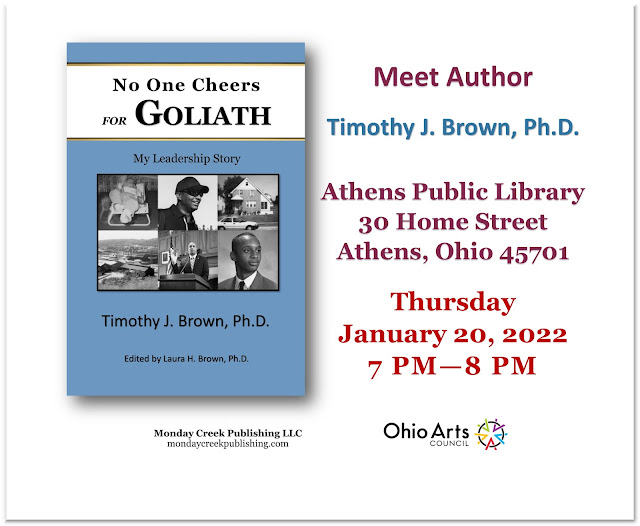
An Interview with Author Timothy J. Brown, Ph.D.

 
An Interview with Author Timothy J. Brown, Ph.D.
 
Timothy J. Brown, Ph.D. is the Dean of Liberal Arts at Montgomery County Community College (Pennsylvania USA) where he oversees 15 departments that span the arts & humanities and social sciences. Dr. Brown is a rhetorical scholar whose research, teaching and consulting focus on the intersection of culture, communication, and identity. Prior to his current position, he served three years as the Dean of the James L. Knight School of Communication at Queens University of Charlotte. Previous to Queens University of Charlotte, he was a faculty member at West Chester University of Pennsylvania where he chaired the Department of Communication Studies for ten years. On the national level, Dr. Brown has been a motivational speaker and workshop presenter on leadership skills for the Federal Government’s Leadership Assessment Program. Among his many honors includes being named a Distinguished Teaching Fellow and a Distinguished Research Fellow by the Eastern Communication Association.  He received his B.A. and M.A. in Communication Studies from West Chester University of Pennsylvania and his Ph.D. in Rhetoric from Ohio University. 
 
Welcome, Tim!
 
GM: What is the premise of your new book No One Cheers for Goliath: My Leadership Journey?
TB: Regardless of your circumstances, you can become an effective leader if given the opportunity and support. This premise is supported by the following three themes: 
·  Effective leaders build authentic relationships that unlock the potential in others. 
·  The challenges in your life are preparing you for greater successes.
·  The African American struggle to overcome institutional racism is real. 
 
GM: You have traveled far to where you are today. What has been the motivation for your success?
TB: Internally, I’m a very competitive and driven person. I have high expectations for myself, and I want to be the best in whatever I do. Growing up, I was often overlooked in most areas such as in school and in sports. Being overlooked drove me to excel in whatever task that I undertook. Where I lacked knowledge or skills, I worked to acquire them and to get better. In the process, I noticed that most people were not willing to make the necessary sacrifices to be successful or were not committed to consistently producing at a high level. Regardless of the task, I learned to give my best effort and to take pride in my work even when it was not noticed by others. I learned this work ethic from my parents and from playing sports. I embraced these lessons and applied them to my career in academia. 
 
My work ethic echoes a quote from Bo Schembechler the late legendary football coach at the University of Michigan. My college roommate had the Schembechler quote hanging from his desk, and it stated, “Every day you either get better or you get worse.” That quote summed up my work ethic, and it became my motivating philosophy.  It has helped me to reach a level of success. It has reminded me to not become complacent. As I reached an accomplishment, I was motivated to start working on the next one.       
 
GM: What advice do you have for students who find it difficult to persevere?
TB: Find your purpose and embrace it. Surround yourself with people who are motivated and who encourage you in your endeavors.  Support others as you would like to be supported. Set your own goals and set them high.  Find mentors who can encourage you when times get tough. Be humble and continue to work hard; network and be ready for your next opportunity. I tell students that often we don’t pick our opportunity; our opportunity picks us. Don’t be afraid to pursue an opportunity. You’ll never reach your potential or grow as a person, if you don’t take some risks and, if you don’t take the opportunities that come to you. 
 
GM: As a writer, how do you maintain thoughts and ideas? 
TB: My key has been finding time to reflect upon ideas as they come to me, write them down, then develop a plan for turning the ideas into a finished product whether a conference paper, journal article, or book. Depending on the type of writing, I might organize my ideas in an outline then develop them or I might write free style, then work on organization and grammar later. 
 
For my book, the title and the chapters came to me in a dream. It was so vivid; I was able to remember everything and write it down on paper. I later typed them up as a document. After a few months, I made time to develop each chapter writing freestyle. As the chapters took shape, I went back and worked on organization, the development of ideas, and grammar. A great deal of time was spent perfecting the “voice” of the book and editing the grammar.  I totally enjoyed the process. 
 
GM: Who is your favorite author?
TB: Frederick Douglass. I’m constantly amazed by his personal story—how he escaped slavery and taught himself to read and write. His quest to educate himself propelled him to become one of the most powerful advocates for freedom and liberty of the 19th Century. Douglass would become not only one of the most compelling voices of the abolitionist movement but one of the most notable champions of freedom, equity, and inclusion of all time. He was an abolitionist, journalist, newspaper editor, political figure, recruiter for the union army, and informal advisor to President Lincoln. He was the nation’s conscience. It is astounding that during his lifetime, he rose out of slavery and poverty, oppressed at every turn by the U.S. government to later represent the U.S. government as its Ambassador to Haiti. 
 
His ability to use his personal story, via three autobiographies, to eloquently argue against slavery and all forms of discrimination is incredible. Given our troubling times, his writings and speeches addressing voting rights, discrimination, inhumanity, and hypocrisy are just as relevant today as they were a century ago. 
 
GM: What are you currently reading? 
TB:  I’ve starting reading Barack Obama’s A Promised Land. As I mention in my book, I admire him as a black man in leadership who held the highest position in the nation—I could identify on a smaller scale the issues a black leader has to confront. Obama always handled himself with class and grace regardless of how others treated him. I’m looking forward to reading more about his experiences and how he handled various situations yet maintained his character and dignity.   
 
GM: Describe a day in your life...
TB: Being in an academic leadership position no day is the same which keeps my work interesting. In general, I start with my 5am morning exercise which prepares me for my workday. My workday will include a series of meetings where we engage in discussion of policies, curriculum, etc. Each day I engage in short-term and long-term planning. 
 
In addition, no day is complete without one or two issues arising that need to be addressed and resolved. After my workday is completed, I typically like to unwind in the evening watching the news and my favorite show Pardon the Interruption with Michael Wilbon and Tony Kornheiser. 
 
GM: Besides writing and collecting memories, what do you like to do for fun?
TB: I enjoy playing sports and coaching sports. I like spending time with my family and binge watching shows such as Mandalorian and Squid Games. In addition, I like exploring our local parks and walking trails. As I mentioned previously, I’m a huge fan of the show PTI as I thoroughly enjoy their banter and perspective on sports. I would love to be a guest co-host.   
 
GM: Where do you see yourself in ten years?
TB: I would like to be a university president. I’m convinced that I could make a positive impact as a university president. Higher education needs someone like myself who understands the struggles of students and has ideas for transforming a campus into a place were students feel connected and supported. 
 
Connect with Dr. Brown
Amazon
Barnes & Noble
LinkedIn
Email: tjbrown712@gmail.com


Tuesday, December 31, 2019

Universal Wisdom: An Interview with Sandra Mendelson, Animal Communicator


Universal Wisdom: An Interview with Sandra Mendelson, Animal Communicator
By Gina McKnight
Archived from the December 2019 issue of Florida Equine Athlete
No duplication without permission (c).

Communicating with animals is not a new idea. People have been talking to their pets since the beginning of time. But how many of us can hear our pets talk back? Not many, I suppose. To hear what your pet has to say, we need an expert. Sandra Mendelson is an expert Animal Communicator. She is a “channel of animal consciousness” connecting with animals “to create deeper bonds of understanding.”

An intriguing subject, Sandra tells us that communicating with animals can bring health and well-being to both an animal and it’s human partner. There is so much to say about this process and how it can enhance and propel our lives. Sandra is the author of We Walk Beside You, a profound look into the insights of animal communication.

Welcome, Sandra!

GM: Sandra, your services are invaluable to so many. Hearing what our pets have to say creates a greater bond. When did you realize you could communicate with animals?
SM:  Happy to say, I came quite late to the party (maybe this will inspire people to realize, you don’t have to be aware of your abilities starting in childhood!).  I first “heard” a horse in 2012, when I was 52 and was doing photopuncture (acupuncture with light instead of needles) on his injured leg. A voice - that was not my own - boomed loudly in my head: “THIS HAY IS CRAP” – and five minutes later, one of the horse “moms” showed up and announced, “There’s mold all over the hay.”

GM: That’s amazing! Of course, mold on hay can be a real health issue! When in a session with a client and their animal, what is the process?
SM: I first schedule a phone conversation with the human alone. This gives them time to share their story, their concerns about/questions for their pet and anything they want me to know about their relationship.
Next, they email me a photo of their pet and, if the pet is still in physical form, I have them ask their pet’s permission for me to connect with them.  EG: "Max, is it ok with you if my friend Sandra tunes into you?  Please feel free to tell her anything you want to share with me” (note: I've never gotten a "no" from the animal yet - if the human wants to connect on a deeper level, the animals have always been on board!).  However, there is always the chance that the animal will not want to participate so we have to honor that.  If they clearly walk away or show any negative behavior such as pinned ears, that would be a “NO”.

I then tune into the animal and the session takes however long it needs.  Finally, I type up and send the transcript to the client via email.  Sometimes, the client wants to delve deeper (eg: their pet has made suggestions and they have questions about moving forward), so we schedule a follow up mini session.

GM: How can I, as a horse owner, delve into this type of communication with my horse? Is it possible? Or do I need a special skillset?
SM: All humans have the innate ability to communicate with animals and understand what they are saying, to some degree. Every one of us possesses intuitive capabilities that make this possible, we are just not taught how to identify or access them in our society.  I wrote an article that describes these gifts, known as “the clairs” e.g.: clairvoyance, clairsentience, etc. and how to get started using them to connect with animals. Animals are the greatest teacher in this regard! You can find the article on my website here: https://www.smendelson.com/post/2018-03-01-how-to-start-connecting-with-animals

In short, I believe the extent of our individual abilities has a lot to do with our personal life path and what we are meant to learn in this lifetime.  In other words, not everyone needs to write books, but they can begin understanding animals more deeply by meeting them on their level.  This means getting out of the “monkey mind”, learning to be fully in the moment, to receive and not strive for outcomes, and to trust what they feel, sense or “just know”, outside of their five senses.

GM: Please share with us one of your favorite anecdotes…
SM:  One woman called me because she was very concerned about her Border Collie Lola’s behavior, which had inexplicably become so aggressive that she had stopped taking her to agility competitions.  She was increasingly afraid of her behavior in public, anywhere.  Well, as it happens the woman underwent three serious knee and hip operations/replacements over the previous year and a half.  Lola just blew my mind; here is a snippet of what she had to say:

“Nothing and no one will ever get the better of her again – mark my words!  It’s more than just what happened physically;  I HAVE to be vigilant and keep negative energies away from her; they’re EVERYWHERE and can be carried by ANYONE (human or not).”

Me:  You know she has to walk her own path.

Lola:  NO! NO! NO! She’s not paying attention!  This is craziness and it’s obvious to me but not to her.  I look like the one with the problem, but I don’t care what anyone thinks.  Who else can point this out and protect her?  It’s a good thing you asked because she just thinks I’m nuts!

Well, the woman cracked up laughing, saying “that sounds exactly like her.”  As follow up, I asked the client to keep reassuring Lola that, “Now, with my new hips, I am stronger than ever and really safe.”   A week and a half later, the client emailed me that she took Lola to an agility competition and the aggression was gone: she was her happy self once again.

GM: Lola sounds like a really caring dog! What animals do you care for and do your own animals help you to communicate with other animals?
SM:  At this time, my animal partner is a dog named Mister T.  He doesn’t get involved in my client sessions, but he has helped me tremendously to trust what I get, be fully in the moment and out of my monkey mind (all critical to successful animal communication).  His messages are featured several times in We Walk Beside You, and one reader just told me that “He is a guru; the ‘T” stands for truth.”   He also came up with the idea for the children’s books!

GM: Do you sometimes find that an animal needs to talk with their owner (through you) in order to lead a successful life? Have you seen this result many times?
SM: Without fail, when a client has contacted me because of their pet’s odd/troublesome behavior, there have always been issues the pet needs to share in order to move forward.  One client adopted a dog who would just freeze up in terror, out of nowhere, and stop eating and drinking for three days at a time.  As soon as the dog shared the details of what she survived during her 10 years at a Romanian “asylum” she became calmer, more affectionate and trusting…and the terrors stopped.  Even while I was texting with her human right after the session, he was shocked that she came over and laid at his feet – something she had never done.   They truly begin healing, once they are heard.

GM: In general, which animal (dogs, cats, horses, etc.) do you see often, or is it a good mix? Are horses, for instance, easier to communicate with than dogs, or does it depend upon the individual animal?
SM:  Well, since my clients contact me virtually, they could be calling about any kind of animal since I don’t need to be there with them.  I get the most dogs, cats and horses, followed by small pets like guinea pigs, turtles, etc.  As for ease of communication? It’s always an individual thing; one horse took three months until he was ready to talk to me while I was writing We Walk Beside You…but, oh boy- when he finally spoke, it was breathtaking!  However, for individual sessions, I always ask my clients to get their pet’s permission beforehand. So, it’s really a team effort and the animals have always been on board and willing to talk. In the wild, some animals will talk, some won’t – again, it’s an individual thing based on how evolved they are, and whether they want to make the effort to create greater understanding among humans.

GM: As an author, you have written a series of children's books. Tell us about your children's books and how they can influence children to connect with animals.
SM:  As I mentioned, the children’s books were my dog, Mister T’s idea, not mine!  I kept asking him “what happened to you?” as he had been found on the side of the road.  Here is what he told me:

“I could tell you my story, but I don’t dwell on hardship. I envisioned the life I wanted, and it became so. Humans can do the same, but they don’t believe it. I prefer to focus on teaching children to use their internal eyes and ears (their hearts and bellies) so they can hear us and know how powerful they are. We can help them trust themselves this way and look inside themselves for answers!”  He continued: 

“This is not schoolbook learning; it is inner wisdom and must be cultivated from a young age. Children need to say or write down what they feel when they are with us, because they are still pure enough to bring through the truth of the messages we send them. They can show their parents what we share with them if they are encouraged to do so.  If they are watered like a plant, even just a little bit, their innate abilities will no longer be buried and become inactive and forgotten.” I think it would be very important and you should tell the other animals and have them contribute what they want to say to kids.”

So, I took his suggestion to the animal kingdom, having no idea that I would receive such willing participation.  Animals are just wonderful at raising children (both theirs and ours!).  They are also quite clear about the tools that can help today’s children realize their own intuitive gifts, so they become the adults of tomorrow who are more self-aware, inner-directed,  grounded, joyous, and empowered. The premise of The Secrets of the Animals trilogy - using real animal messages set to rhyme- is to share these tools in a fun, non-preachy way: 

Mister T acts as narrator and guide, taking children on a different adventure in each book:  In Book 1 travelling through the neighborhood, in Book 2 down on a farm and, in Book 3 (still unpublished), they venture out into the jungles, forests, oceans and plains of the world. On each journey they meet different animals, each of whom shares a special secret “Animal Wisdom Way” that helps children believe in themselves and trust their intuitive voice, which enables them to understand what animals are communicating. 

GM: Sandra, you are certified in Equine Photopuncture, Light Therapy, and you are also a Health and Nutrition coach. All of these tools require skill and technique. You work a lot in Light Therapy. What is a Polychromatic Light Therapist?
SM: Someone who is professionally certified to simultaneously apply two or more wavelengths of light (color) to the body, from light emitting diodes (LEDs).  The light is pulsed at the frequencies of different tissues in the body and stimulates the body’s own regeneration mechanism, accelerating the healing of pain, inflammation and infection.

GM: Please share whatever you would like with the world about light therapy and how it can enhance our life...
SM: Polychromatic Light Therapy is a non-invasive, drug-free therapy that has been proven and utilized by NASA for decades.  It supports the body’s own healing mechanism by increasing circulation and blood flow; as a result, pain and inflammation decrease or disappear, and back and joint pain, bone fractures, soft tissue injuries and bruises, burns, peripheral neuropathy, non-healing wounds, mood disorders, skin conditions, traumatic brain injury and more, typically heal much faster. 

The most significant point, however, is that you don’t need to be certified to buy and use a light therapy device on yourself, family, friends and your pets. You just have to make sure you buy one that:

1)  Delivers light that is pulsed at the healthy frequencies of the body’s tissues (spurs healing much faster).  These are called Nogier frequencies.  You’d also want the system to include Solfeggio frequencies which are very calming and de-stressing – because a body in a stressed state has a very hard time healing.

     2) Provides polychromatic wavelengths: these different colors such as visible red and blue, and invisible infrared light, each reach different depths and tissues in the body

     3) Is a Class 2 medical device, meaning it is FDA cleared for at-home use. You don’t want to mess around with inferior, knock-off products (and there are lots of them on the market) as they have already proven to be dangerous or ineffective. 

If you’d like to know more about light therapy and what it is used for, check out the following link:

Connect with Sandra…
Have a question? Email Sandra…  sandra@smendelson.com

Gina McKnight is a freelance writer from Ohio USA.


Cowboys for Christ: An Interview with Chaplain David Gillett

  Cowboys for Christ: An Interview with Chaplain David Gillett by Gina McKnight No Duplication Without Permission Archived from the October ...

Monday Creek Publishing LLC

Subscribe

* indicates required

Intuit Mailchimp