Showing posts with label Horses. Show all posts

Friday, March 25, 2022

EQUUM: A collection of 4444 animated horses in the metaverse.


Equum is a collection of 4444 animated horses in the metaverse. Offering exclusive access to our in game experience where you can breed, train and compete for prizes with your horse! 

We are also giving away more than US$100,000 in prizes during the first drop. Make sure to go follow our discord for a chance at our whitelist!

Website:
https://www.equum.ca/
Discord:
https://discord.gg/c3gNHxRP77
Twitter: @equumco


Monday, July 20, 2020

At Huachipa They Lost the Bets by Carolina Yepes


At Huachipa They Lost the Bets

Almost 10 years ago, I was invited to work as a foreign veterinarian at an equestrian club near to Lima-Peru, after the loss of several horses because of lack of appropriate medical attention, especially in urgency cases, and after facing the toughest challenge, both personal and professional till that moment, and still being a newcomer, I wrote the following storytelling: 

Last Tuesday, after a long working day at Club Ecuestre Huachipa, near to Lima, and after being for a while inside a traffic jam, I got to an internet cafe to communicate with my family, and as soon as I sat down, I had a call to attend a colicking horse: The first horse colic in Peruvian territory. Then I grabbed a taxi, which took me to La Molina neighborhood in Lima, to meet the owner of  Mozo de Caba (the sick horse) and, together, go back to Huachipa. We arrived at the club at 9:15 pm, and I went to my office to get ready all the basic stuff to attend Mozo de Caba, and suddenly its owner shows up pretty upset, almost crying and she says Carolina: The horse is pretty bad. I went to see the horse and in fact, it was sweating, barely standing, and its vital signs were not good at all.

Capturahua ~ Photo by Carolina Yepe (c)

Capturasalto - Photo by CArolina Yepes (c)

I got everything ready and some club members in solidarity showed up to help. To be honest, I must say that I was in front of the worst colic I ever attended until that day. Mild analgesics were not working at all, so I needed something stronger, so I could keep working with the horse. The "fun" thing was that I was surrounded by people wanting to help, but no one had any idea of what to do and that was complicating things a little, and I was not sure where to start, because I had some things to do at the same time. As a treasure, I had with me 2 endovenous catheters, which I took from Colombia (because in the time I was in Lima, I couldn't find them in the market), and these would be the tools which were going to allow me to keep giving fluids to the horse for a long time, and although I explained this to my helpers, and that it would be important to keep the catheter in place while fixing it, they let both catheters out of the vein: both were lost.  This meant the beginning of long endovenous hydration using regular needles, and I was thinking that if they let the catheters go out of the vein, the needles had no future.   

On the other hand, as soon as I got in the club for the very first time, I was asking for ringer lactate for fluid therapy, but in Lima, I learned something new about this matter: They used 5 lt of sodium chloride and they thought it was enough, so given the circumstances, anything was better than nothing, so getting together all the fluids they had, I gathered a total of 13lts: still not enough. I moved on with the protocol and I remember to hear them talking about what I was doing and saying: We never sought someone doing what you're doing. After about 2 hours, or so, everything I knew that could help the horse was done, and the horse was getting worse, not better. If there was a horse clinic around (an around I mean in Peru), I would have derived the horse immediately, but I hadn't that option, so I was alone with this horse and the club members who wanted to help. At that point, I asked them to call my mentor, who brought me there and who was in Bogotá-Colombia, and he told me: Keep the horse hydrated and you will have a patient. It was like midnight, and I was managing needles and losing the veins to work because once I put my attention in another issue, and the horse moved, the needles went out and the person who was holding the horse didn't care much. I felt that water was getting into my ship, but as it was, I should keep giving fluids to this horse. It was 4 am, and the horse stabilized, so I decided to stop hydration, we let the horse rest for a while, and I fell asleep inside the box with him, and after half an hour I went to sleep at my home's couch (my house was not ready yet) for another hour. Suddenly: knock knock in my door, it was Mozo de Caba's owner saying: Carolina, the horse is not well. And I thought: No way, but these things are like that. Let´s begin once again: needle, fluids, analgesics, nasogastric tube. I spoke to my mentor once again, and he made them understand the urgency of finding ringer lactate, and I don't know how they got it, or where, but they brought a bunch of ringer lactate bags by 9 am.  By noon, I was reaching 6 hours beside the horse and holding the needle by myself, and at this point, I barely had 5cm of the vein to work, and now my ship was sinking: The horse was getting worse.  All the bets of the club members were going that the horse would die: just before I arrived, they lost 3 horses, so statistics and experience dictated that Mozo de Caba should die too. The owner was crying besides me, and she was even offered "the injection" to put him down. But my mentor from Bogota encouraged me to continue with other medical treatment options. 

At any point I was able to eat and drink something, and desperately I needed to go to the bathroom and I let the groom taking care of the needle and as it was expected, he let it out: Believe it or not. Then I asked my mentor: How long do you think this is going to take? I did not want to leave the horse alone, but I was starting to feel tired. He said: Caro, be patient and get ready for another long sleepless night; it was like 2 pm. As the vein was lost, again, I took the horse out of the stall to try to empty his stomach anew, this time successfully accomplished. They took him for a hand walk and when he came back, I left him stable in the stall. I went to visit my other patients in the club, and when I came back to Mozo de Caba's stall, my dog who was my faithful co-worker and adventurer was pulling me through the horse's box, and what do I see? The horse which 2 hours earlier had the muzzle on the floor and barely stood was now standing very well, calmed, stable and with his eye, he told me: I'm feeling fine. Yes, it was shocking to see. We kept watching and treating him till 10 pm, and again I fell asleep in his box, with the horse and my dog, who joined us all this time, and since Mozo de Caba seemed to be fine, was resting and looking good and calm, I went back to my couch for half an hour... Half an hour? The owner waked me up at 5 am. The horse spent the night so calm, that he was sleeping soundly, stretched over his shavings bed, and his owner thought he died and we didn't realize, but it was a new dawn and Mozo de Caba was still alive. We took him for a hand walk and to eat some grass and the club members who followed the step by step of this journey were telling me: How is he? -Fine, I answered excitedly and surprised they confirmed: Fine? Is he alive? And I said: Yes, he is alive and stable for 12 hours now: no analgesics, no fluids. I think in Huachipa they lost the bets and in what way. They were as thrilled as they were amazed that Mozo de Caba went to the other world and came back and now he was grazing in the club fields, and well let me tell you that this was the best presentation letter. My mentor congratulated me, also people did, the owner was more than excited, the other club members were confident and Mozo the Caba was alive. Now ringer lactate was a trend in Huachipa and they were bringing not bags, but boxes. After a few days, Mozo de Caba got a fever, we carried out some laboratory analysis and it turned out he had his immune system kind of weakened, so we treated him and at the time I wrote this, he was sound and jumping again.

Carolina Yepes
Bogota-Colombia-South America

Connect with Carolina...

Friday, October 5, 2018

Equiderma: The World's Greatest Equine Products


Horse Rescue Help

Orphaned Foals From the Wild Mustang Slaughter!

10% of all sales in October 2018 will go to


Please help them!
Free Shipping on All Orders Over $100.00
Orders Under $100.00 $7.50 Flat Rate


9 AM to 5 PM EST Monday - Friday (800) 573-1020

Sign up for Equiderma's Newsletter here!

USA


Friday, September 7, 2018

Five Springs Farms, Virginia, USA


Welcome to Five Springs Farms
Horse Retirement and Full Boarding Riding Facility in Virginia
Mike and Debbie invite you to visit and take a tour of our farm


Welcome to Five Springs Farm, we are a family owned farm offering a Horse Retirement Boarding facility in Virginia.

Our farm sits on 134 acres of beautiful gently rolling hills, lush green pastures, woodlands and springs. We are so blessed to be in the center, or as we Virginians call it "The Heart of Virginia” where we are only one hour from the scenic Blue Ridge Mountains of West Virginia, and a few short hours from the North Carolina beaches.

A perfect place to retire your horse in beautiful lush pastures and three board fencing, with pampering and friendly companions, including Angel our mini that is quit the nurturing little mother! Be sure to go to Horse Retirement and Horse Pics Page for more detailed information.

We are a full care horse retirement boarding facility/Semi Retirement and only keep a few horses here at a time, instead of boarding large herds. Therefore, we are able to give each one the individual care and love they need.

Most of our horses that have come to live with us have been top show/ performance horses, and are living the life a horse deserves after giving so much of themselves. Now, it is the love of their owners that gives back to their faithful companions to allow them to live out their remaining golden years in a way that is simple, without stress and lazy days eating grass under shade trees with friends!

These horses become part of our lives, and are here with us till the end!

Connect with Five Springs Farms...


Sunday, September 2, 2018

Sunday, May 6, 2018

HORSE SCOUT


Connect with thousands of horses and horse professionals!
The Global Essential Equine & Equestrian Network

HORSE SCOUT
Exceptional horses for sale, and so much more...


Tuesday, May 1, 2018

Solutions for Wellness: Horse Owners!

Solutions for Wellness
Horse Owners!
Meet Sandra Burnett USA

For horse lovers who want to be in the know, there is a "vet blanket" that promotes rehabilitation for your horses, reduces stress during transportation or competitions, and much more!

Call Sandra Burnett 505-699-5229 for more information.   


Friday, February 9, 2018

HORSEMANSHIP AND EQUINE ASSISTED PROGRAMS & THERAPIES by Franklin Levinson

Franklin Levinson at work. 

www.acourseinhorse.com

www.horseconscious.com


HORSEMANSHIP AND EQUINE ASSISTED 
PROGRAMS & THERAPIES
by  Franklin Levinson       


I have been a professional horseman, trainer and instructor since the age of 17. At 13 I was the youngest registered polo player in the United States. Now, at 71 years of age, I have been a paid professional trainer and instructor for over 50 years. I was fortunate to have established my own horse ranch on the island of Maui in the early 80s and began a horse trekking business into the beautiful tropical outback of Maui’s pristine north shore. This business operated for over 30 years. Prior to moving to Maui, while working as a riding instructor at large summer camps in Michigan, I discovered that if I taught the children something about the nature, language and psychology of horses, how to handle them on the ground, along with how to ride them, the entire experience was elevated into discovery about themselves as well as about life itself.  A simple riding lesson became an exercise in developing self-awareness, kindness, compassion, integrity and mindfulness. Additionally, the skills of good leadership and how to have a successful team experience were also part of this unique learning program.

Early on, I learned about the significance of developing trust with horses. I love to ride but learning about how and why trust is so important to a horse, brought whatever I did with a horse to a higher and safer level. Trusting it is safe is paramount to a horse and the most important aspect to its life. Developing trust with the horse became the first and foremost thing I did with all horses I interacted with. I began teaching ‘horse’ to all who came to work or ride with me.

In the late 80’s I heard about Equine Experiential Learning (EEL) which was started by a woman named Barbara Rector in Arizona. I was very interested in ways of developing the horse/human experience beyond humans riding horses, so I signed up for one of her programs. This experience significantly changed my life. It wasn’t long after that I began my own Equine Facilitated Learning (EFL) program called The Maui Horse Whisperer Experience. This was not a program that merely ‘used’ horses within its process. I wanted a partnership with the horses involved. This decision to consciously and intentionally, ‘partner’ and not just use horses, set my program apart from many others that began to pop up around the country. My focus was not to only to develop a program that was beneficial to the human but was unquestionably beneficial to the horse at the same time. To accomplish this, I needed to be able to impart some basic knowledge of horses to the humans who came to me.

I visited many other equine assisted programs in those early days and was often disappointed, and even angered, at what I saw. I frequently saw horses emotionally abused by humans who knew little about the nature of horses and seemed to care even less. I would question the humans providing these programs and was frequently told their focus was entirely on processing the human through the program and not about horses or teaching anything about horses. It became obvious to me that these people knew little of the real nature of horses. “That this was not their job”, was a refrain that was often repeated to me. For a time, I became a publicly outspoken critic of these other equine facilitated programs. One had already become a nationally recognized organization. They did not care for me as I had gained some credibility and notoriety in the field by that time and was openly and publicly critical of them. Here is an example of a common exercise that made my stomach upset; they would give a halter to a human and tell them to go and put it on a horse. They never said or explained anything about the horse or the piece of equipment. So here is a human with a piece of horse equipment and told to fasten it on to a horse and no information about the horse or equipment given. The facilitator would then proceed to psycholonize that human based on the struggle the human had with the horse and task. Imagine if this was a 7-year-old child and the equipment was the shoulder pads of a football uniform and the adult had never seen a helmet, knee or shoulder pads used before. So now you have an adult struggling to put this equipment on the child and the child being made afraid by the struggling of the human. This is what I saw happening to horses during these and similar exercises. A human who is unsure around them will often create fear within the horse.

In the beginning, the normal model for an equine assisted program was for there to always be an equine professional present. Eventually, this requirement was dropped because so many folks doing the work felt they had all the horse knowledge needed and the added expense of paying another person was unnecessary. It seemed that if someone had owned a horse in their life or ridden a fair amount that was all the horse experience they needed to do this work. This was and still is the norm in many places doing this work. It can be easily seen that the horse becomes a fearful victim because of the ignorance of the humans no matter how well-intentioned they are.


My intention with this short treatise is to motivate as many of the people doing this work that I can, to gain the experience and knowledge with horses to understand what it really means to develop a trust-based partnership with a horse doing any activity with a human and especially within the process of an equine assisted program. If a program is not as beneficial for the horse as it is for the humans involved, don’t do it. Be part of the solution in resolving this unfair and unsatisfactory situation regarding horses participating in any equine facilitated program. Any mutually successful relationship with a horse is life enriching for both.

Connect with Franklin...


Tuesday, February 6, 2018

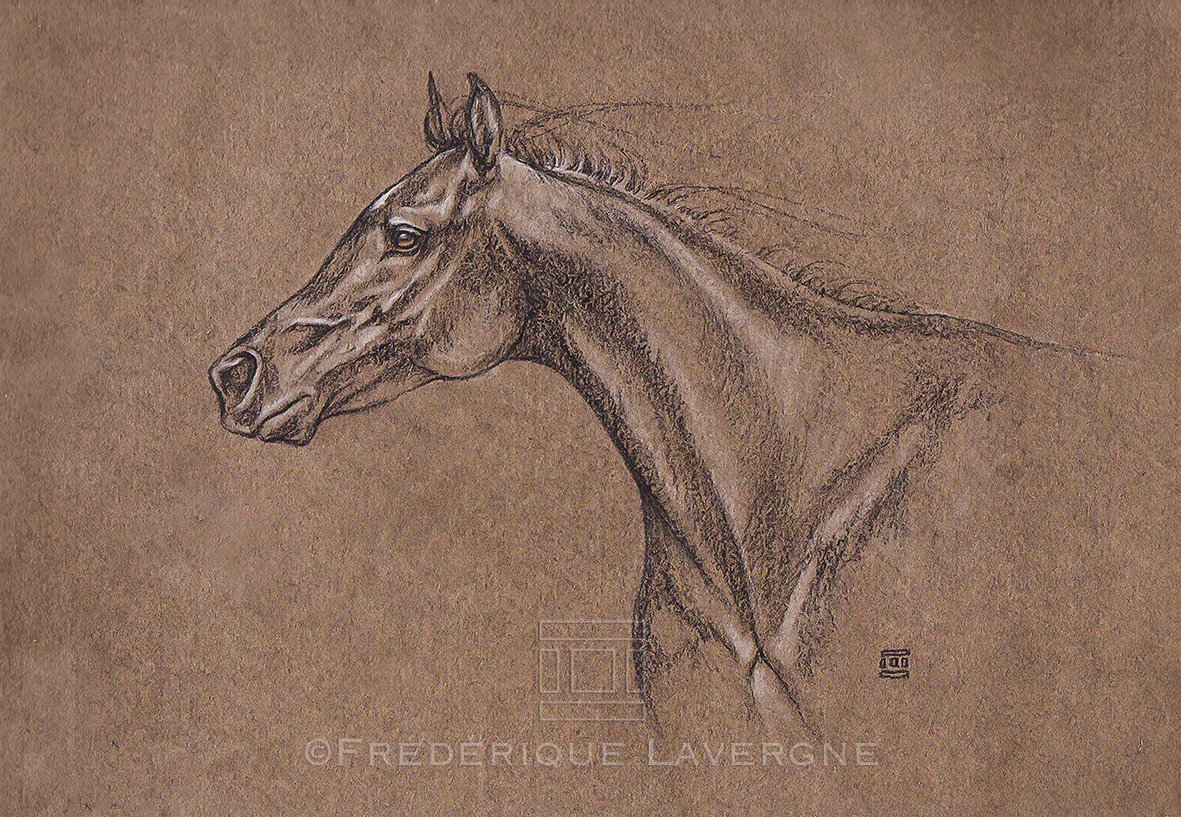
Painting in France: An Interview with Fine Artist Frédérique Lavergne

(c) Copyright Frédérique Lavergne
Painting in France: An Interview with Fine Artist Frédérique Lavergne
by Gina McKnight

Archived interview from the January 2018 Issue of Arabian Finish Line.
No duplication without permission.

“Arabian horses seem to live above the floor.”

From her large studio window, overlooking her perennial garden and beautiful horses, Frédérique Lavergne loves to paint. The romance of the French countryside, coupled with the smell of horses and fragrant woodland, enhances Frédérique’s creativity. Frédérique writes, “I need to be connected with horses. This is all I need to feel good for painting.”

A world-renowned artist, I caught up with Frédérique and we talked about her art and life with horses…

GM: What sets the Arabian Horse apart from other horse breeds?
FL: Arabian horses seem to live above the floor, just like if they were constantly flying. A legend says they were created from the wind, but this sounds real when you see them moving, with the nose open, just like if they were breathing the wind which created them. Didn't God say, "I will make you fly without wings”? See the moving, so lightly, a bit like cats do, so proudly, remembering who they are, and where they come from.

GM: That is a profound description of the Arabian horse! You know them well, Frédérique! When commissioning a portrait of a horse, what do you require?
FL: When I am commissioned, I appreciate to receive several photos, or videos. If I can't meet the horse himself, I need the photos or videos to catch his spirit and soul. Because if you only paint the outside of the horse, his image, the portrait won't reflect who he is, which is the most important to put on the canvas. I also need to have a description from the owner, the way he sees the horse, what he shares with him, where the painting will be hanged (even if possible, a picture of the room where it will be). This is to catch what the client wants to see on the painting, which side of the personality of the horse. Because a horse can be seen very differently by two people, and when I do a commission, I want the client to have his horse, seen by himself, but painted by me on the canvas. When I do a commission, I want to paint the horse like the client would do if he could do it himself. Remains from me of course, my strokes, my way of composing, how I understood the horse and the relationship he has with his owner.

GM: Your art is truly stunning. You capture the essence so beautifully. What mediums do you use to create a masterpiece?
FL: I paint with oil on canvas, or paper. I use brushes or palette knife. When I draw, I use black stone, which is the pencil that was used by the Dutch master to do the sketches on the canvases before painting. I like these because they are deep black, as charcoal, but not powdery. I use white chalk also, ink and walnut tint

GM: Does lighting and environment play an important role in the finished portrait?
FL: Lighting is essential in my way of painting. It’s because, as I said before, I don’t want to paint only the "surfacing image" even as beautiful as it is. I want to paint the soul and the spirit of the horse. What makes him be what he his. And this is a kind of mystery which needs to pop out from the dark, or to stay a bit in a chiaroscuro, because the soul can't be entirely seen and understood.

GM: You have so many lovely portraits that are my favorites. Do you have a favorite Arabian portrait from your own collection?  
FL: My favorite Arabian portrait from me is the one on black background. 

GM: Portraying all horse breeds, where has been your best encounter with horses?
FL: I could say first that wherever I can meet a horse is the right place. But really meet them, not just see. I need time with a horse. I need to touch him, to smell him, to feel him. And whatever breed he his, the encounter happens...  I especially had that kind of experience in Portugal, but recently, I have been twice in Mongolia, in June (summer) and January (winter!). I was with breeders, and their horses which live so differently than our horses live. Total liberty, food autonomy, not a lot of contacts with humans. I was thrilled to discover horses as they really are.

GM: Experiencing horses in their natural habit with minimal human contact must have been exhilarating! I know your paintings travel around the world. Where are you currently exhibiting?  
FL: I am currently exhibiting in US, Red Hook, New York, Equus Art Gallery; in Ireland Greenlane Gallery; in Italy, Firenze, Porcellino Gallery; in France, Rouge Garance Gallery and L'Art en tete Gallery.

GM: From my last conversation with you, I remember you mentor novice artists. Do you have advice for starting equine artists?
FL: I have been doing that full-time job since 2000. And sincerely, I would say to any beginner, keep a job out of art. Just to avoid the pressure on your art. The best way to live it, is, if possible, to never depend financially of it. Because when you need to get money each month from your painting, the challenge is really harsh to produce real deep pieces. Just as if you were just painting to express your passion for horses and art. It’s possible, but really difficult because you must go on painting, year after year, just as if you were not waiting for people to like the result, but just to express your talent thrust the tribute to horses.

GM: As an avid horse-lover, knowing both the spiritual and physical attributes of horses, what does horsemanship mean to you?
FL: First of all, real horsemanship isn't possible without connection. in any discipline. I have learnt this with my own horse. I have had two accidents, and haven’t been able to ride. I was wondering what I could do with my horse, I wanted to keep a relation with him, but I couldn't even take him for a walk or grazing. I had my knee broken, then a surgery, and a year after I had five ribs broken and lung perforated. I couldn't take the risk to get pulled by the rope if the horse moved his head too quick. So, I tried to work through "comportemental approach" at liberty, without being close to him at all. Connection is essential then!! And after that, I learnt that the connection you create, helps a lot in any equestrian discipline you practice.

Since I went to Mongolia, horsemanship has got a new meaning to me. Now, my way is mostly to stand with horses and learn from them. Not asking anything. Just studying their behavior, and trying to catch what they have to "tell" us, what they are telling from their link to universe. I also met Jean Francois Pignon and his horses recently. I have learnt a lot from him. The possibility of getting things from horses just with "talking-horse". We often try to make the horse learn things from us, but we do it with the language we think horses can understand. Maybe this is not wrong, but what I am sure of now, is that it is not the more direct and efficient way. This way is to learn how to talk-horse. Jean Francois Pignon shows evidence of this. It is so rich and full of emotions! It feeds my creativity.

Connect with Frédérique…

Gina McKnight is a freelance writer from Ohio USA. gmcknight.com


Friday, October 13, 2017

Thursday, October 12, 2017

Colonial Wagon and Wheel


Recently, while dining at Lake Hope Lodge, McArthur, Ohio, with a friend, we stopped after lunch in the Lodge Gift Shop to browse. As horse-lovers (always), we caught a glimpse of a metal horse with a stone in the center. There were many really cool metal designs - ranging from very tall lawn/garden hooks/figures, to small frogs and bugs. Of course, we each had to buy a horse... what should be a yard ornament sits in my office (see below). The stone in the center of the horse is unique and the horse is shaped around the stone...


Visit www.colonialwagonandwheel.com for more, or if a local, stop by Lake Hope Lodge. The designs are quality, heavy art pieces that will stay in your yard/garden (office) forever. 

Thanks Colonial Wagon & Wheel!   


Tuesday, October 10, 2017

The Chestnut Mare: A Horse Story by Author Clyde Hoch


The Chestnut Mare: A Horse Story
by Author Clyde Hoch

A few days ago, I received this note from a friend. I almost forgot about this until she reminded me of it. Remembering back, I remember the horse, I remember feeling very confident about getting on the horse. I felt in my heart this is something I can and will do. I just knew I could do it. My friend writes…

I remember the time my first husband and I had horses and one of them was only “green broke.” Autumn had never been ridden. She was a beautiful chestnut mare with a black mane and tail that reached the ground. She was a very spirited horse and you volunteered to break her for us. I was very nervous and tried to persuade you otherwise, fearing for your safety but you insisted you would be fine and up you went into the saddle! Well, that horse bucked and bucked, hooves into the air and every which way but you had one arm in the air like a true cowboy and stayed on that horse until she quit bucking and just settled down. Something I will never forget. Thank you for that memory!
Your friend, Ruth Harvey!!

I remember this horse. As the horse bucked I started to enjoy the ride, it was fun. My friend Ruth said I was smiling the whole time. When Autumn finally settled down and stopped bucking, I felt let down. This was a big rush for me. I was probably 25 years old at the time, a few years after returning home from the Vietnam War. After Vietnam few things gave me a rush in my life. Riding Autumn was surly one of the few. In my area there was not a lot of demand for breaking horses, unfortunately.


About the Author
From Pennsburgh, Pennsylvania, USA, Sergeant Clyde Hoch is an acclaimed author, recently winning the coveted Readers Favorite Bronze Medal for his book A Man Down!  I have several of Clyde's books in my library; recommended reading!

A consultant for screenplay writers, and much more, Clyde is a Vietnam War Veteran, public speaker, and mentor. In his books, Clyde shares his wartime experiences and the challenges of being a war veteran. 

Connect with Clyde…

Read Clyde's childhood story about Spike, a cherished Clydesdale...

Books by Clyde Hoch:

Tracks Memoirs of a Vietnam Veteran This is Clyde’s military experience as a tank commander in Vietnam.

A Tribute to Tankers has a short description on a type of tank and follows with stories of people who served in that type of tank in combat, starting with WWI and ends with Iraq.

B. A. R. Man Browning Automatic Rifle Man is the story of a young man who does some amazing things in the Korean War until he is wounded and captured by the Chinese. He is forced to march 200 miles with no medical attention. He is held as a POW for two and a half years.

A Man Down is the story of four young men who gave their lives for their country. This book won a bronze medal from Readers Favorite.

Albion is Clyde’s first work of fiction. It has eight chapters. Each chapter is a different story and different period in time.

God Help Me! Cause No One Else Will is Clyde’s sixth book. It is about post-traumatic stress disorder and veteran's suicides and how to prevent them. 

Book Launch! George H. Wood "The King of Clemens: A Novel"

  George H. Wood’s forthcoming novel, The King of Clemens , from Monday Creek Publishing, is a vivid, deeply human portrait of a small Appal...

Monday Creek Publishing LLC

Subscribe

* indicates required

Intuit Mailchimp